The above photo shows the crags that need to be avoided for an ascent of Beinn Maol Chaluim. One could skirt left to meet the north ridge, but I took deer paths right and up very steep slopes, which while I was on safe ground was very hard work, especially while carrying wet overnight gear.
Beinn Maol Chaluim and Sgor na h-Ulaidh
MunrosSgor na h-Ulaidh
|
CorbettsBeinn Maol Chaluim
|
30-31 July 2025
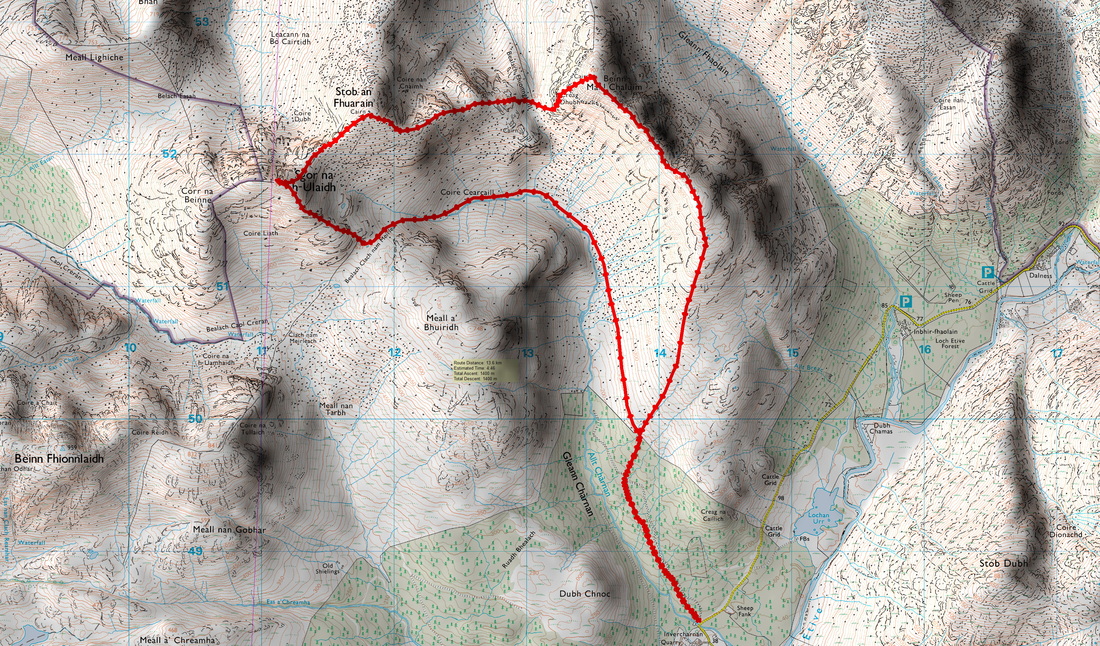
My route was revised over the years when I realised that there is a good forestry track and path leading about 500m up the mountain from Invercharnan. My entry into the forest changed too. While there was initially a path leading from the summit of Beinn Maol Chaluim, this seemed to fade and I opted to join the track that joins the forest near to the Allt Charnain.
This route had been very much top of my list for some years. I was going to do it a year earlier following Stob Dubh and Stob Ghabhar, but due to a combination of tiredness, laziness and family life pulling me back home, I had left it for another day. The hills are not going anywhere!
As is often the case, I started later than planned, though this was not too much of an issue as I was carrying overnight gear in the form of a sleeping bag and bivvy bag. I decided not to carry a stove, but eat a pre-made Wayfayrer meal, cold, from the bag. This would be enough for one night out and save a bit of weight, though that should be balanced against that the fact that I was not carrying dehydrated food.
Firstly, there was the repair of my ride-on lawnmower. It had been making funny noises so that I had tipped it on its side to clear the grass. On restarting, it bellowed out white smoke. I think that tipping it over had flooded the engine. I had arranged to have it picked up and repaired. I had left the shed unlocked so that David could collect it while I was out. Two days later, as I was heading off for the hills, my wife commented on the fact that we needed it back. I told her to check the shed. She returned to say that is was just as we had left it. The question was whether David had repaired and returned it or if it had not been collected in the first place. I was not going to start it within the confines of the shed as I did not want to breathe in the fumes. I breathe heavily going up the hills these days as it is! phone calls and returned phone calls established that it was fully fixed. I assured my wife that I would mow the lawn as soon as I returned from the hills.
The next hold up was the A9 being closed and I had to follow a diversion via Invergordon. There had been a single car crash at 2a.m. that morning, sadly resulting in the death of a 29 year old woman.
Firstly, there was the repair of my ride-on lawnmower. It had been making funny noises so that I had tipped it on its side to clear the grass. On restarting, it bellowed out white smoke. I think that tipping it over had flooded the engine. I had arranged to have it picked up and repaired. I had left the shed unlocked so that David could collect it while I was out. Two days later, as I was heading off for the hills, my wife commented on the fact that we needed it back. I told her to check the shed. She returned to say that is was just as we had left it. The question was whether David had repaired and returned it or if it had not been collected in the first place. I was not going to start it within the confines of the shed as I did not want to breathe in the fumes. I breathe heavily going up the hills these days as it is! phone calls and returned phone calls established that it was fully fixed. I assured my wife that I would mow the lawn as soon as I returned from the hills.
The next hold up was the A9 being closed and I had to follow a diversion via Invergordon. There had been a single car crash at 2a.m. that morning, sadly resulting in the death of a 29 year old woman.
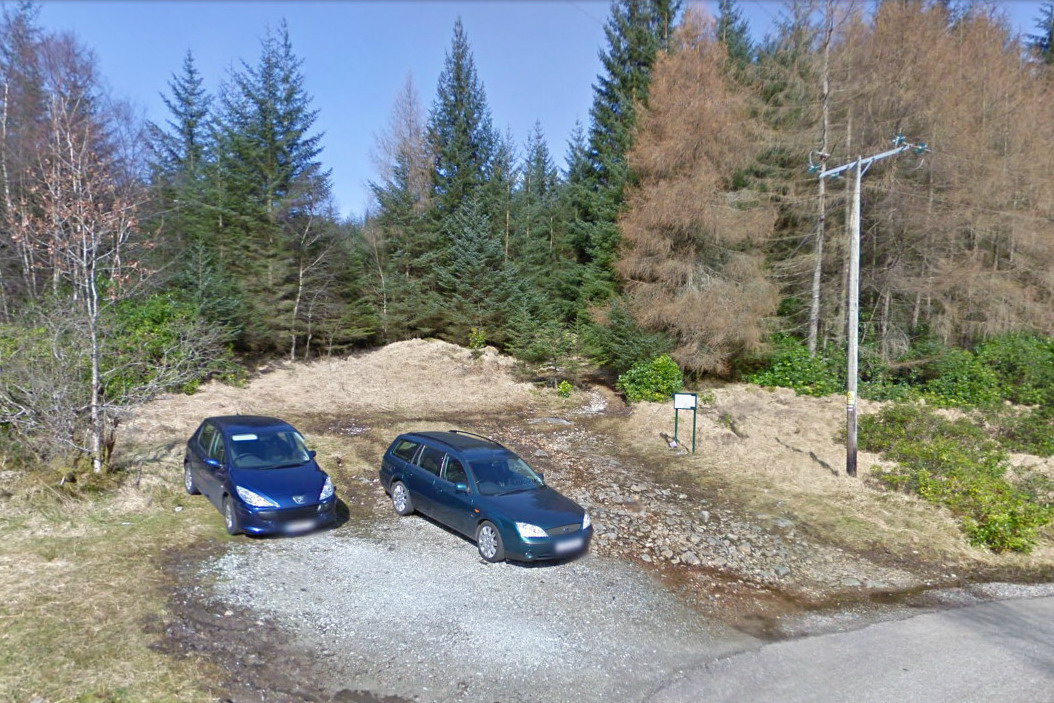
This was a route that was planned earlier, and the image of a small parking area taken from Google Maps years earlier, no longer looked the same, so I drove past the starting point and I had to turn round and go back to find somewhere to park.
The weather was bright but the peaks were still in cloud as I easily gained the first 200m of ascent and emerged from the forest. I did not take any photographs as nothing caught my eye as worth photographing. Continuing, the weather deteriorated, so that I was in thick clag by the time that I reached the top of Meall a Bhuruidh. It was an intermittent, very fine drizzle that meant that I dried out between the wetter periods. However, the rain became increasingly persistent by the time I reached the top of Sgor na h-Ulaidh, my base layer and trousers were very wet. I put on my waterproof jacket. It was a good idea to keep my soft-shell mid layer dry, so I had it to sleep in.
Sgor na h-Ulaidh has a very modest summit cairn considering its status as a Munro. I did not linger for long. I explored a little way to the west before returning to the summit. I looked for a place to lay my bivvy bag but it all looked a bit too rocky, without any nice, mossy flat areas, so I headed towards Stob an Fhuarain, finding a spot a couple of hundred metres east of the summit.
I use a groundsheet/tarp which I pegged out. The problem with this is that unless the ground is completely flat, I tend to slide off it. I just see it as a bit of protection to the bottom of the bivvy bag.
I had a quick drink of Capri Sun before getting in and once inside, I ate some Korean Chicken wraps. I decided that these would be easier and potentially less messy than the Wayfayrer meal. I then decided that I should take off my wet Helly Hansen base-layer and put on my dry mid-layer. While eating, I had been shivering severely and I was a little concerned about either not getting to sleep or drifting into hypothermia and not waking up.
I had always planned this as an overnighter, either with a tent or bivvy bag. I had opted for the latter on account of it being lighter and unaffected by windy conditions. The bivvy bag does not require such a large footprint so less time is spent finding a suitable spot. I had packed it loosely into my pack with the sleeping bag already inside the bivvy bag as it can be a real faff pushing the sleeping bag down to the bottom of the bivvy bag. I had chosen a synthetic sleeping bag. I am fortunate enough to have a choice of sleeping bags that I have bought over the last 40 plus years - 3 down and 2 synthetic - different weights and temperature ratings.
I used to use a double hooped bivvy tent and although coffin-like, the fabric was supported and it did have just a bit more room for changing clothes. In this bivvy bag, it was is very difficult, especially with wet clothing that clung to the skin. I ended up pulling a muscle in my shoulder.
However, with persistence, I eventually got changed into my dry clothing. That, combined with the fact that I had just eaten, meant that I felt warmer. As far as my limited freedom of movement allowed, I did some exercises to generate a little heat, the idea being that I just needed to warm up the inside of the sleeping bag a bit.
Being cold invariably means having to get up for a pee during the night. I was dreading that moment, but at about 1 a.m., the time came to get out of the relative warmth of my sleeping bag and enter the cold, wet and dark world outside. Then it was a case of getting back inside without my kit wet and then doing a horizontal funky chicken dance to generate some heat before getting off to sleep again.
I was awake and out of my bivouac around 05:30. It was till wet and windy, so I packed everything into my pack and was off towards Stob an Fhuarain. Beyond Stob an Fharain, I found a much nicer spot for either a bivvy or a camp, with the ground being both flatter and looking drier.
As I descended the western ridge and approached the bealach connecting Sgor na h-Ulaidh with Beinn Maol Challuim, the weather began to slowly clear and I was able to take some OK photographs that were not just grey mist.
Sgor na h-Ulaidh has a very modest summit cairn considering its status as a Munro. I did not linger for long. I explored a little way to the west before returning to the summit. I looked for a place to lay my bivvy bag but it all looked a bit too rocky, without any nice, mossy flat areas, so I headed towards Stob an Fhuarain, finding a spot a couple of hundred metres east of the summit.
I use a groundsheet/tarp which I pegged out. The problem with this is that unless the ground is completely flat, I tend to slide off it. I just see it as a bit of protection to the bottom of the bivvy bag.
I had a quick drink of Capri Sun before getting in and once inside, I ate some Korean Chicken wraps. I decided that these would be easier and potentially less messy than the Wayfayrer meal. I then decided that I should take off my wet Helly Hansen base-layer and put on my dry mid-layer. While eating, I had been shivering severely and I was a little concerned about either not getting to sleep or drifting into hypothermia and not waking up.
I had always planned this as an overnighter, either with a tent or bivvy bag. I had opted for the latter on account of it being lighter and unaffected by windy conditions. The bivvy bag does not require such a large footprint so less time is spent finding a suitable spot. I had packed it loosely into my pack with the sleeping bag already inside the bivvy bag as it can be a real faff pushing the sleeping bag down to the bottom of the bivvy bag. I had chosen a synthetic sleeping bag. I am fortunate enough to have a choice of sleeping bags that I have bought over the last 40 plus years - 3 down and 2 synthetic - different weights and temperature ratings.
I used to use a double hooped bivvy tent and although coffin-like, the fabric was supported and it did have just a bit more room for changing clothes. In this bivvy bag, it was is very difficult, especially with wet clothing that clung to the skin. I ended up pulling a muscle in my shoulder.
However, with persistence, I eventually got changed into my dry clothing. That, combined with the fact that I had just eaten, meant that I felt warmer. As far as my limited freedom of movement allowed, I did some exercises to generate a little heat, the idea being that I just needed to warm up the inside of the sleeping bag a bit.
Being cold invariably means having to get up for a pee during the night. I was dreading that moment, but at about 1 a.m., the time came to get out of the relative warmth of my sleeping bag and enter the cold, wet and dark world outside. Then it was a case of getting back inside without my kit wet and then doing a horizontal funky chicken dance to generate some heat before getting off to sleep again.
I was awake and out of my bivouac around 05:30. It was till wet and windy, so I packed everything into my pack and was off towards Stob an Fhuarain. Beyond Stob an Fharain, I found a much nicer spot for either a bivvy or a camp, with the ground being both flatter and looking drier.
As I descended the western ridge and approached the bealach connecting Sgor na h-Ulaidh with Beinn Maol Challuim, the weather began to slowly clear and I was able to take some OK photographs that were not just grey mist.
I used to run down slopes like these, admittedly not with a large pack, but now, after a number of sprained ankles and slightly sore knees, I descend with great care. Unless there is a good path and a gentle gradient takes me almost as long to descend the hills as it does to climb them. I surveyed what lay ahead - go left and join the north ridge or bear right and ascend the steep slopes to join the ridge just south of the summit. I went for the right hand option, crossing a couple of streams along the way. There are some shallow stone filled gullies, but the rocks were unstable and I found it more energy efficient to stick mainly to the vegetation.
I was certainly glad to reach the ridge. Combining Beinn Maol Chaluim with Sgor na h-Ulaidh with steep ground between the two was always going to be one of the most challenging Corbetts. Of course, climbing Beinn Maol Chaluim would be a much easier proposition, with about 700m less ascent, but somehow, it did not appeal. I always like to take a circular route and whoever possible have combined the Corbetts with neighbouring Munro's and Grahams. The effort was spread over an afternoon and the next morning with more than half the ascent done on day 1. There are two cairns. The first is larger but seems lower. This photograph was taken at the second, smaller cairn at 09:53, when many would be starting up the hills.
There was still a lot to do. In places, the walking is easy, while in others, some care is required. The weather continued to clear as I descended. Some people see no point in walking the hills in bad weather as you do not see the views. I have always maintained that there is so much more to see and and sense out on the hills; the vegetation, leaping frogs, different rocks .... and fungi.
I think that this is Amanita nivalis. Most Aminita species are poisonous.
The cloud base was rising and eventually, I was able to photograph some of the other mountains. I have both a colour and monochrome version of this. On this occasion, I prefer the monochrome one.
Looking east from the south ridge of Beinn Mall Chaluim to Buachaille Etive Mor - Stob na broige, Glen Etive and Creise.
I could also look back at where I had been - The descent ridge from Sgòr na h-Ulaidh/Stob An Fhuarain, the bealach and Beinn Maol Chaluim to the right. The ridge down from the Munro does require some care to avoid the broken crags.
While the gradient was easing, it was not easy ground with loose rocks and holes hidden in the vegetation. I avoided the bracken as much as possible as I am far more likely to pick up ticks when walking through bracken, the little buggers reaching out for the fabric of my trousers and crawling upwards before inserting their evil mouthparts into my flesh. I truly hate ticks!
I was glad to reach the track and enter the forest. The track is becoming overgrown, mainly with rhododendrons. These are an invasive species and are a serious concern in parts of Snowdonia. Presumably, these plants spread from one of the estate properties in Glen Etive. In my opinion, they need to be kept under control to stop their spreading across the hillsides.
As I said earlier, hillwalking is not just about the views. Scotch Argus (Erebia aethiops) - not my best ever photograph but they are rather skittish and I would have obtained better results with my 70mm or 100mm macro lenses rather than at 40mm non-macro. I also tried to photograph them on the other side of Glen Etive a year ago.
This was a challenging photograph with the fungi being low down among vegetation, I had to lie down on the wet ground. The Scarlet Waxcap fungi (likely Hygrocybe coccinea or Hygrocybe miniata).
The walk could be done in a single day, even by me, with my current level of fitness, but it is nice to arrive back at the car early afternoon and have time to stop the car and take the occasional photograph, drive part of the way home and head out to a bothy, still arriving at a reasonable time.
Below: Buachaille Etive Beag - Stob Dubh and Buachaille Etive Mor - Stob na broige.
This is the classic Scottish Highland view of Black Rock Cottage and Buachaille Etive Mòr. This appears on post cards and elsewhere. There is a new car park to the left of the building and the last time I was here, a car spoilt the composition. I got down low so that nothing of the car part can be seen. It is not just what you photograph but what you leave out of the frame!
After lunch at the Glencoe Mountain resort, I headed for the Bridge of Oich. Driving up the Great Glen along the A83, I momentarily nodded off, waking up to find myself having drifted halfway across the the other lane. Thankfully, I woke up and the oncoming traffic was still some distance away. A past student of mine is believed to have done the same but she was not so lucky. The accident that had resulted in the closure of the A9 was a single vehicle accident and it seems likely that was the result of her falling asleep at the wheel. I think that I will avoid large meals after hiking if I am to drive any distance and a bit of AC/DC in the car may help. Some of us are luck enough to get a warning of what might happen, so that we can take steps to avoid being another statistic on the UK roads.
Shortly afterwards, I was parked up and sorting out my gear to cycle to Achadh-nan-darach. This has been taken on by the MBA in recent times. It is only about a four kilometre bike ride followed by a short walk. I was really looking forward to a dry night in a cozy bothy!